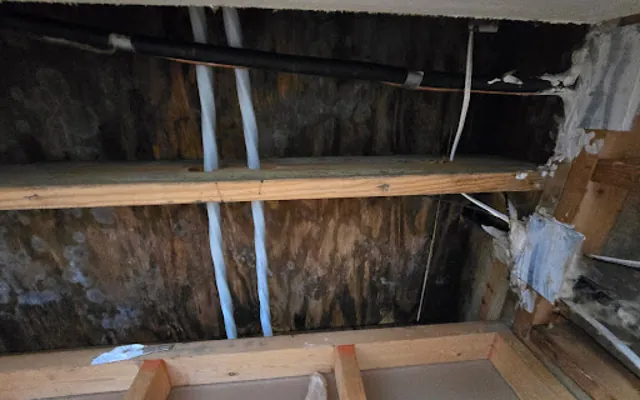
Aging supply lines and water heaters are failing across the Medical District. Crews diagnose burst pipes and appliance failures fast, extract the water, dry the structure, and help landlords and owners move fast so tenants can return.

Crews identify the burst line or failed appliance, shut off water or power, and map moisture in the affected units. For multi-unit buildings, crews check adjacent spaces so no tenant returns to a surprise.
Pooled water is extracted and removed from all affected units. Saturated insulation, drywall, and flooring are pulled out to expose the subfloor and framing so air movers can reach every wet zone.
Daily moisture readings guide air movers and dehumidifiers in each unit until all framing and subfloors test dry. Crews treat surfaces with antimicrobial and coordinate with maintenance to schedule supply-line repair or appliance replacement before residents return.

Roof leak water damage cleanup in Medical District commonly runs about $1,200 to $6,500. Cost depends on how much water entered, how much insulation and drywall must be replaced, and how far the water tracked through the attic and walls. The roof repair itself is separate. Sudden storm and hail damage is usually covered by homeowner insurance, and crews document the loss and coordinate with your adjuster.
The Medical District wraps established residential streets around Huntsville's hospitals with a dense mix of older single-family homes, apartments, and rental units. Aging supply lines, water heaters installed years ago, and multi-unit plumbing in close quarters mean a burst pipe or appliance failure can reach more than one household in hours, and landlords cannot afford delays. Medical District buildings cluster aging fixtures and shared supply lines so one burst pipe, a failed water heater, or a washing-machine supply-line blowout can soak more than one unit fast. Decades-old plumbing installed before modern code standards means corrosion and weak joints that fail without warning. From Medical District, crews also cover nearby Dallas Mill Village, Five Points, Old Town, Twickenham, Lincoln Mill Village, Downtown Huntsville. See every neighborhood and town on the full service area page.
See all areas servedEvery loss is photographed, measured, and logged from the first visit, so the paperwork holds up with your insurance carrier.
Technicians follow recognized IICRC drying standards and prove the work with daily moisture readings, not guesswork.
Emergency dispatch any hour of the day or night, with a real crew on the way, not a callback in the morning.
A real crew dispatched any hour, not a callback in the morning.
Trained technicians following recognized IICRC drying standards.
Truck-mounted, portable, and submersible for any size loss.
The loss is documented and billed to the carrier directly.
That depends on your insurance and the lease terms. Commercial or multi-unit policies often cover sudden water loss and resulting cleanup. The job is to extract water, dry the structure, and document everything so each property owner can file with their insurer. Crews coordinate directly with your adjuster.
For an apartment building, extraction and active drying takes about five to seven days. Once surfaces test dry and crews remove the equipment, tenants can return. Crews aim to get the Medical District building operational again as fast as possible because crews know downtime costs landlords money.
Crews are on call 24 hours a day and can be on the way to Medical District within the hour.
Call (256) 485-6233