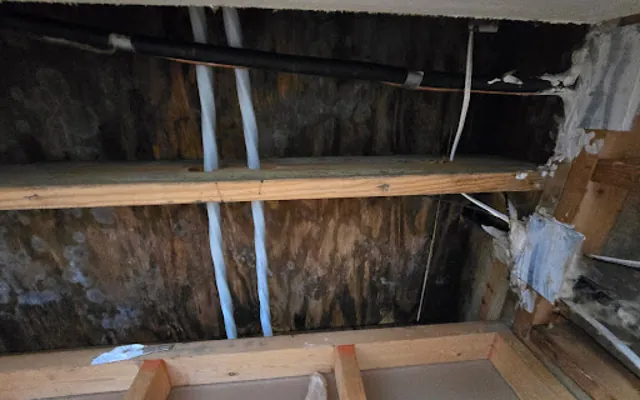
The first move on a Five Points roof leak is finding where water hid in your century-old home, stopping it, and drying every cavity before damage spreads to original hardwood floors and plaster.

Thermal imaging and moisture meters find water in cavities and floors you cannot see. Crews photograph entry points, map saturation patterns, and determine whether water reached crawlspace or slab before any drying equipment starts.
Standing water is carefully extracted from crawlspaces and attics. Insulation and drywall only come out if too far gone to save, protecting original wood and finishes whenever possible as crews expose framing to air movement.
Air movers and dehumidifiers run with daily moisture readings until all hidden cavities test dry. Crews document progress with photos and readings for your adjuster, then coordinate permanent roof or supply-line repair.

Roof leak water damage cleanup in Five Points commonly runs about $1,200 to $6,500. Cost depends on how much water entered, how much insulation and drywall must be replaced, and how far the water tracked through the attic and walls. The roof repair itself is separate. Sudden storm and hail damage is usually covered by homeowner insurance, and crews document the loss and coordinate with your adjuster.
Five Points was Huntsville's first subdivision, laid out in the 1890s, and now forty-odd blocks of historic homes listed on the National Register of Historic Places. Century-old supply lines, hand-built porches and additions, and hidden cavities mean water can travel silently through walls and ceilings for days, undermining original hardwood and fine plasterwork before anyone sees damage on the surface. Five Points homes have a century of supply lines, wiring, and plumbing threaded through hollow wall cavities and under original hardwood. A roof leak or a burst fitting can travel those hidden paths horizontally and down, reaching crawlspaces and foundation areas well before it surfaces in a ceiling or wall. From Five Points, crews also cover nearby Dallas Mill Village, Medical District, Lincoln Mill Village, Lowe Mill Village, Old Town, Twickenham. See every neighborhood and town on the full service area page.
See all areas servedEvery loss is photographed, measured, and logged from the first visit, so the paperwork holds up with your insurance carrier.
Technicians follow recognized IICRC drying standards and prove the work with daily moisture readings, not guesswork.
Emergency dispatch any hour of the day or night, with a real crew on the way, not a callback in the morning.
A real crew dispatched any hour, not a callback in the morning.
Trained technicians following recognized IICRC drying standards.
Truck-mounted, portable, and submersible for any size loss.
The loss is documented and billed to the carrier directly.
Soft spots in wood, musty smells, water stains on ceilings, or visible mold are signs water reached spaces you can see. Thermal imaging can reveal moisture in cavities inside walls before it surfaces, which is why crews start every job with thermal scanning on a Five Points home. It tells the crew the full picture.
A small surface leak might dry with portable fans, but century-old cavities and multi-level moisture paths in Five Points homes need industrial air movers and dehumidifiers to reach all the wet zones. Trying to dry yourself risks trapping moisture inside walls and starting mold in places you cannot monitor. The equipment and daily moisture readings ensure you get truly dry.
Crews are on call 24 hours a day and can be on the way to Five Points within the hour.
Call (256) 485-6233