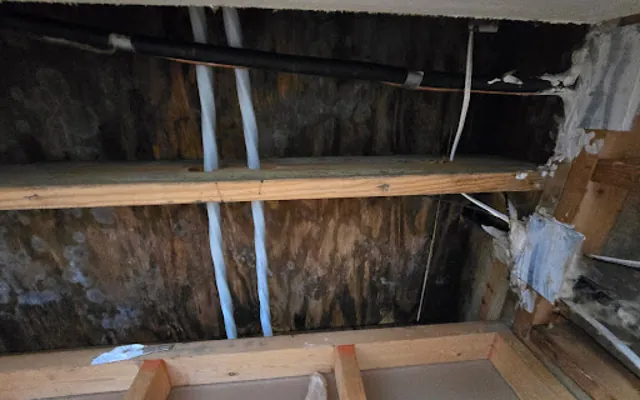
Harvest's newer subdivisions mean tight building envelopes where water travels fast through walls and crawlspaces. The crews reach this growing north Huntsville community quickly, drying your home aggressively before moisture spreads into structural cavities that newer construction depends on.

Crews evaluate Harvest homes for standing water, determining whether truck-mounted extraction is needed before drying can begin. Crews map moisture in walls, crawlspaces, and attics, prioritizing the tightest cavities where vapor barriers can trap moisture.
Air movers and dehumidifiers are positioned in Harvest crawlspaces and wall cavities to create airflow before moisture condenses on insulation. Crews run equipment aggressively, monitoring daily so drying stays ahead of any potential mold growth in the Harvest subdivision's tight construction.
Once Harvest homes are dry, crews replace any insulation or drywall, treat affected materials with antimicrobial, and coordinate any plumbing repairs. Your Harvest home is fully restored, with modern construction standards maintained throughout.

Ice dam water damage cleanup in Harvest typically runs about $1,500 to $6,000 on the rare occasion it occurs. Cost depends on how much water backed into the attic and ceilings, how much insulation and drywall must be replaced, and how far the water traveled inside. Roof repair is separate. Sudden storm-driven damage is usually covered by homeowner insurance; crews document the loss for your adjuster.
Harvest is a newer planned community north of Huntsville, with subdivisions of contemporary homes built on former agricultural Madison County land. Tight building envelopes and modern materials mean moisture problems spread fast in Harvest, and newer supply lines can still fail unexpectedly. When a pipe ruptures or a roof backs up in Harvest, swift drying prevents damage to finishes and framing. Harvest's newer construction means insulation is packed tight against vapor barriers, and wall cavities can trap moisture if not dried quickly. Modern HVAC systems depend on balanced humidity, so water intrusion affects air quality and material durability. The sandy Madison County soil drains quickly, but interior moisture from supply-line failures spreads fast in Harvest homes. From Harvest, crews also cover nearby Owens Cross Roads, Gurley, Hazel Green, New Market, Triana, Meridianville. See every neighborhood and town on the full service area page.
See all areas servedEvery loss is photographed, measured, and logged from the first visit, so the paperwork holds up with your insurance carrier.
Technicians follow recognized IICRC drying standards and prove the work with daily moisture readings, not guesswork.
Emergency dispatch any hour of the day or night, with a real crew on the way, not a callback in the morning.
A real crew dispatched any hour, not a callback in the morning.
Trained technicians following recognized IICRC drying standards.
Truck-mounted, portable, and submersible for any size loss.
The loss is documented and billed to the carrier directly.
Newer construction means tighter building envelopes, so moisture can spread through insulation and wall cavities faster. However, modern materials also dry quicker with proper equipment. Early response is critical in Harvest subdivisions to prevent any mold growth.
Newer construction in Harvest typically dries faster than older homes because materials are uniform and cavities are sealed tight. Crews usually complete drying in four to six days with continuous equipment, depending on the extent of water intrusion.
Crews are on call 24 hours a day and can be on the way to Harvest within the hour.
Call (256) 485-6233