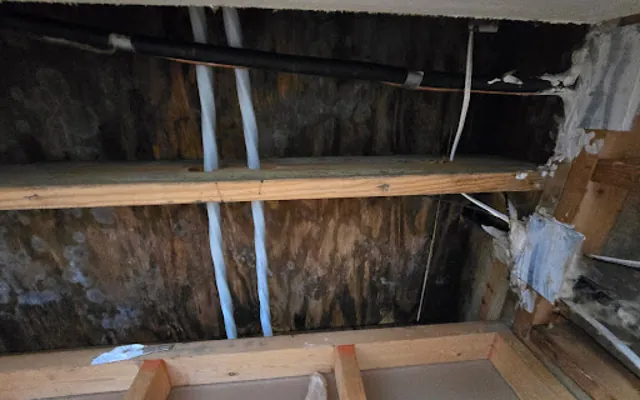
Slab leaks in Harvest's newer subdivisions hide for weeks until a warm spot or high water bill surfaces. The crews use thermal imaging to find the leak, dry the foundation, and coordinate permanent repair.

Crews scan Harvest slab floors with thermal imaging to find warm spots where supply-line leaks are occurring. For storm damage, crews assess how water entered and where it pooled.
Dehumidifiers and sump equipment remove moisture from under the slab and from any garages or low rooms where storm water entered. Daily soil-moisture readings guide the drying process.
Once the foundation and garage are dry, crews help you coordinate with a leak detection specialist and plumber on permanent repair. Slab leaks often require rerouting supply lines above ground to avoid future problems.

Roof leak water damage cleanup in Harvest commonly runs about $1,200 to $6,500. Cost depends on how much water entered, how much insulation and drywall must be replaced, and how far the water tracked through the attic and walls. The roof repair itself is separate. Sudden storm and hail damage is usually covered by homeowner insurance, and crews document the loss and coordinate with your adjuster.
Harvest is a large suburban community northwest of Huntsville, built out with newer subdivisions and a scattering of older homes on former farmland. Slab foundations dominate the newer streets, where a quiet slab leak can run for weeks undetected, while a severe spring storm can overwhelm yard drainage and send water toward garages and lower rooms. The scale of Harvest means many homes at similar risk simultaneously when weather events occur. Harvest's newer homes sit almost entirely on slabs with supply lines running under the foundation, where corrosion, age, or pressure fluctuations can create small leaks that run undetected for weeks. Heavy spring storms or failures in yard drainage can push water toward garage floors and lower rooms where it pools and creates mold risk, especially when drainage swales are new and not yet mature. From Harvest, crews also cover nearby Owens Cross Roads, Gurley, Hazel Green, New Market, Triana, Meridianville. See every neighborhood and town on the full service area page.
See all areas servedEvery loss is photographed, measured, and logged from the first visit, so the paperwork holds up with your insurance carrier.
Technicians follow recognized IICRC drying standards and prove the work with daily moisture readings, not guesswork.
Emergency dispatch any hour of the day or night, with a real crew on the way, not a callback in the morning.
A real crew dispatched any hour, not a callback in the morning.
Trained technicians following recognized IICRC drying standards.
Truck-mounted, portable, and submersible for any size loss.
The loss is documented and billed to the carrier directly.
Standard homeowner policies do not cover gradual leaks or maintenance issues, but they may cover sudden water loss if the leak is due to sudden failure of the supply line. Rerouting the line above ground is usually considered a maintenance upgrade and costs come out of pocket, but drying the foundation after a leak is often covered. Check your policy and ask your adjuster.
No. Any slab leak, even a small one, will continuously put moisture under your foundation and into the soil, eventually causing cracks, floor heaving, or mold in crawlspaces or adjacent walls. Early detection and repair prevent much bigger problems down the road. Small Harvest slab leaks discovered early are cheaper to fix than those that run for months.
Crews are on call 24 hours a day and can be on the way to Harvest within the hour.
Call (256) 485-6233