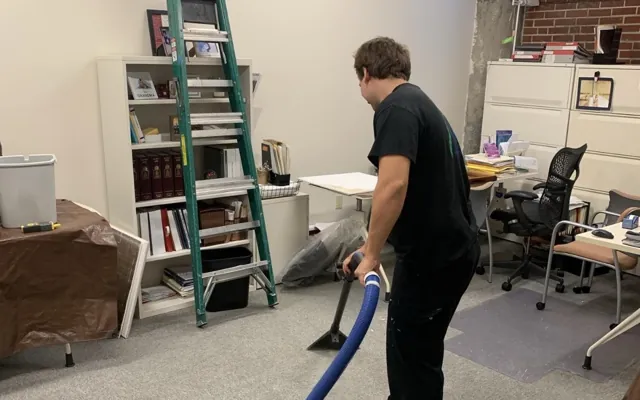
Water from a Medical District slab leak starts beneath your home, travels through crawlspace or subfloor, and ends up in your living room or next door to a renter. The local IICRC-standard crew moves fast to extract it all and dry your Medical District home before mold reaches the upper floors.

Crews use moisture meters to follow where water traveled from the Medical District slab into walls, crawlspaces, and adjacent rooms, so crews do not miss moisture hiding behind walls or under insulation.
Once the source is sealed, crews pump and extract water from Medical District crawlspaces and basements, remove affected subflooring and baseboards, and open up hidden pockets where moisture is trapped against framing.
Dehumidifiers, air movers, and specialized drying mats cover the Medical District slab, subfloor edges, and wall bases as crews check readings each day until all moisture is gone and mold growth is prevented.

Slab leak cleanup in Medical District typically runs about $1,500 to $6,500, not counting the plumbing repair to fix or reroute the line beneath the concrete. Cost depends on how long the leak ran, how much flooring warped, and how far moisture wicked into walls and baseboards. Sudden pipe failures under a slab are often covered by homeowner insurance; crews document the loss for your adjuster.
The Medical District wraps established residential streets around Huntsville's hospitals, mixing older single-family homes with apartments and rentals. Aging supply lines and water heaters are common in this dense fringe, and a burst pipe or an appliance failure in a multi-unit building can reach more than one household before a landlord or owner even hears about it. Medical District's mix of rental and owner-occupied housing means many properties have aging water heaters installed in basements or crawlspaces that can burst without warning. Older supply lines under the slab corrode, while spring storms and winter freezes place stress on connections in uninsulated crawlspaces, leading to leaks that spread across framing quickly. From Medical District, crews also cover nearby Dallas Mill Village, Five Points, Old Town, Twickenham, Lincoln Mill Village, Downtown Huntsville. See every neighborhood and town on the full service area page.
See all areas servedEvery loss is photographed, measured, and logged from the first visit, so the paperwork holds up with your insurance carrier.
Technicians follow recognized IICRC drying standards and prove the work with daily moisture readings, not guesswork.
Emergency dispatch any hour of the day or night, with a real crew on the way, not a callback in the morning.
A real crew dispatched any hour, not a callback in the morning.
Trained technicians following recognized IICRC drying standards.
Truck-mounted, portable, and submersible for any size loss.
The loss is documented and billed to the carrier directly.
If a water heater or pipe in your unit fails, your renter or homeowner insurance typically covers extraction and drying. If water comes from a shared plumbing line, the landlord or building owner's insurance usually covers it. Crews work with both parties to document responsibility and get your Medical District home dry fast.
Medical District crawlspaces often have bare soil, and water spreads laterally across the ground, soaking insulation, wetting support posts, and rising through capillary action into wooden framing. Crews extract the pooled water first, then dry the soil and every inch of framing to prevent mold and rot.
Crews are on call 24 hours a day and can be on the way to Medical District within the hour.
Call (256) 485-6233