Lowe Mill Village's early-1900s homes and the nearby arts district draw owner-occupied families to small houses with decades-old plumbing. When a water heater fails or a supply line bursts, water spreads across the subfloor fast. The IICRC crews extract and dry immediately.

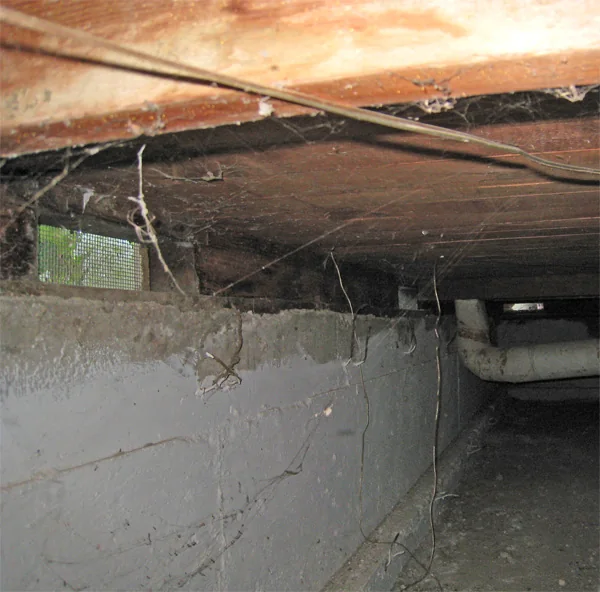
Lowe Mill's small footprints mean tight crawlspace conditions. Crews bring pumps and extractors sized for these spaces and work quickly to remove standing water and assess saturation.
Wet insulation in compact crawlspaces blocks air movement and breeds mold fast. Crews remove all saturated materials by hand and load them out of the tight space.
Air movers and dehumidifiers run continuously in the small space until wood moisture levels drop to safe. Crews monitor daily and protect the compact home from re-wetting.

Crawlspace water removal in Lowe Mill Village typically runs about $1,500 to $6,000. The range reflects how much standing water is present, how much insulation and vapor barrier must be replaced, and whether joists or subfloor need drying or repair after prolonged saturation. Sudden losses from a burst line or storm are often covered; chronic seepage may not be. Crews document the cause for your adjuster.
Lowe Mill Village sits southwest of downtown near the old mill that now anchors the arts district, surrounded by small early-1900s homes that bring the neighborhood's creative energy. Decades-old plumbing and low crawlspaces are the norm, and when a water heater or a supply line gives out, water spreads across the subfloor faster than these compact houses can shed it, pooling against the soil and framing below. Lowe Mill's small, early-1900s homes and low crawlspaces mean water spreads fast and drains slowly. Aged supply lines and water heaters are common failure points, and the red-clay soils and humid valley climate trap moisture that breeds mold in confined spaces. From Lowe Mill Village, crews also cover nearby Lincoln Mill Village, Five Points, Dallas Mill Village, Medical District, Blossomwood, Old Town. See every neighborhood and town on the full service area page.
See all areas servedEvery loss is photographed, measured, and logged from the first visit, so the paperwork holds up with your insurance carrier.
Technicians follow recognized IICRC drying standards and prove the work with daily moisture readings, not guesswork.
Emergency dispatch any hour of the day or night, with a real crew on the way, not a callback in the morning.
A real crew dispatched any hour, not a callback in the morning.
Trained technicians following recognized IICRC drying standards.
Truck-mounted, portable, and submersible for any size loss.
The loss is documented and billed to the carrier directly.
Look for rust on the tank, water pooling around the base, or reduced hot water pressure. If you see any sign of a slow leak in the crawlspace, replace the heater before it catastrophically fails. Crews can document and dry any damage that occurs.
Small spaces mean water spreads quickly and is harder to dry, but it also means extraction and equipment deployment are fast and affordable. Quick professional response keeps a small cottage's damage minimal.
Crews are on call 24 hours a day and can be on the way to Lowe Mill Village within the hour.
Call (256) 485-6233