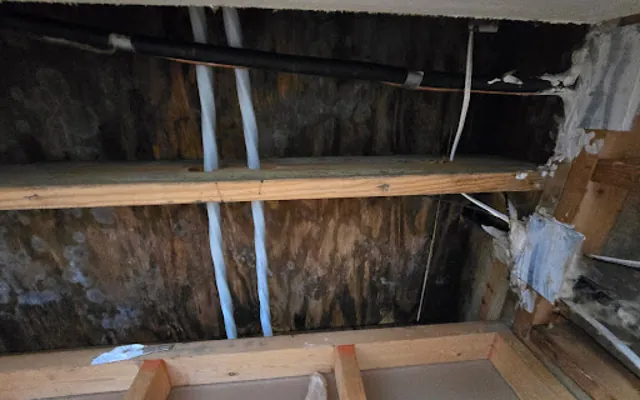
When you spot soft spots in the floor or smell moisture creeping through Lincoln Mill Village's century-old cottages, a leak has already been running for weeks. Crews find it, extract fast, and dry the subfloor before damage spreads deeper.

Crews carefully access the crawlspace and use moisture meters and infrared imaging to locate every damp zone and trace it back to the source, whether a burst pipe, a roof drain overflow, or high groundwater seeping in.
Any standing water is pumped out and properly disposed of. Crews then bag and remove all saturated insulation and inspect the joist and rim board for signs of rot or structural weakness.
Air movers and dehumidifiers run continuously, with ductwork directing humid air outside. Meter readings are taken daily until wood moisture reaches safe levels, and crews treat affected framing with antimicrobial before installing new insulation.

Attic water damage cleanup in Lincoln Mill Village generally runs about $1,200 to $5,500. What moves the number is how much insulation must come out, whether decking or rafters need replacing, and how long moisture sat before drying began. Roof repair is usually separate. When the leak is sudden, from a storm or a burst line, most homeowner policies help; crews document everything and work with your adjuster.
Lincoln Mill Village is another of Huntsville's early-1900s mill neighborhoods, its modest cottages still owner-occupied a century later. The original crawlspace foundations and aging drain runs common here trap humidity, and a winter pipe freeze or slow supply-line leak can rot floor framing long before it surfaces underfoot. Lincoln Mill Village's original crawlspace foundations and aging plumbing lines trap humidity and make slow leaks the norm here. A winter freeze can burst original pipe at the rim board, and the moist crawlspace air means water that pools will stay trapped, rotting framing for weeks before anyone spots soft boards. From Lincoln Mill Village, crews also cover nearby Lowe Mill Village, Five Points, Dallas Mill Village, Medical District, Old Town, Twickenham. See every neighborhood and town on the full service area page.
See all areas servedEvery loss is photographed, measured, and logged from the first visit, so the paperwork holds up with your insurance carrier.
Technicians follow recognized IICRC drying standards and prove the work with daily moisture readings, not guesswork.
Emergency dispatch any hour of the day or night, with a real crew on the way, not a callback in the morning.
A real crew dispatched any hour, not a callback in the morning.
Trained technicians following recognized IICRC drying standards.
Truck-mounted, portable, and submersible for any size loss.
The loss is documented and billed to the carrier directly.
Yes, absolutely. The rim board and supply lines entering from outside are especially vulnerable during north Alabama's hard freezes. Crews recommend insulating exposed lines before winter and keeping the crawlspace ventilation balanced to prevent extreme temperature swings.
With tight crawlspaces and poor drainage here, water can saturate floor framing and begin causing rot within two to three weeks. That's why spotting soft spots or musty smells early and calling the crew immediately is critical. Crews can often save the framing if crews get there fast.
Crews are on call 24 hours a day and can be on the way to Lincoln Mill Village within the hour.
Call (256) 485-6233